


Systems Leadership Theory® · Our Framework
Creating positive organisations.
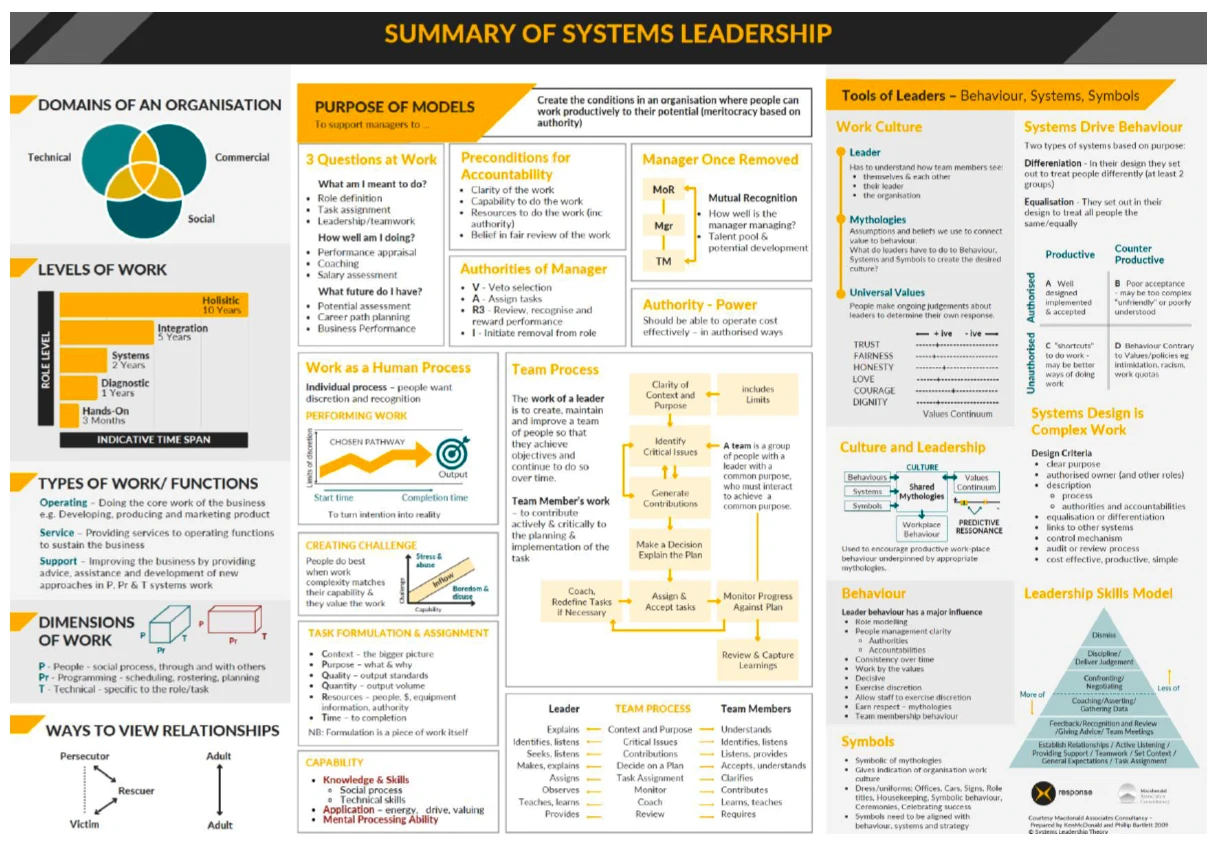
Systems Leadership Theory* (SLT) is an integrated set of organisational concepts, models and tools concerned with how people come together to achieve a productive purpose — a framework for developing, analysing and working with organisations, management and behaviour.
Core Concepts
Six principles behind every productive organisation
For any society, organisation or group to prosper there needs to be productive social cohesion — agreed arrangements about what is acceptable and/or productive behaviour. At its core, SLT relies on understanding six principles of human behaviour that underpin all social interaction.
Predictable environments
People need to be able to predict their environments.
Not machines
People are not machines.
Six universal values
People’s behaviour is based on six universal values.
Cultures form from mythologies
People form cultures based upon mythologies.
Change needs dissonance
Change is a result of dissonance.
Authority, not power
It is better to build relationships on the basis of authority rather than power.
“The fundamental work of a leader is to create, maintain and improve a group of people so that they achieve objectives and continue to do so over time.”
Dr Ian Macdonald© Macdonald Associates Consulting Pty Ltd · www.maconsultancy.com
Domains of Work
Technical, social and commercial — all three, all the time
Systems Leadership Theory* categorises work into three domains that help think about how an organisation is structured, roles are designed, and systems are designed. It is not enough to be strong in one or two: a technically excellent, well-run organisation that treats people poorly won’t keep the capability it needs, any more than a well-liked one that can’t control its costs will stay in business.

Understanding and Organising Work
Three questions every healthy organisation can answer
One of the signs of a healthy organisation is the clarity with which members can answer three questions: What am I meant to be doing? How am I doing? What is my future? Application of Systems Leadership, including Levels of Work and Team Process models, helps people understand their work and supports the creation of a constructive culture.
Free resource
An Introduction to Systems Leadership* Theory Whitepaper
Download the whitepaper for an in-depth explanation of how this framework can create, improve and sustain positive organisations, and facilitate:
- Understanding and Organising Work
- Understanding and Organising Culture
- Bridging Processes between Organising the Work and Organising the Culture
Key Contact
Talk to our team about Systems Leadership

Emma Trumper
Emma leads the team running the behind-the-scenes operations for our business services, consulting and research businesses. She has demonstrated experience in program delivery, budget and project management, and financial oversight, and works closely with the Systems Leadership Development Association supporting their work.


